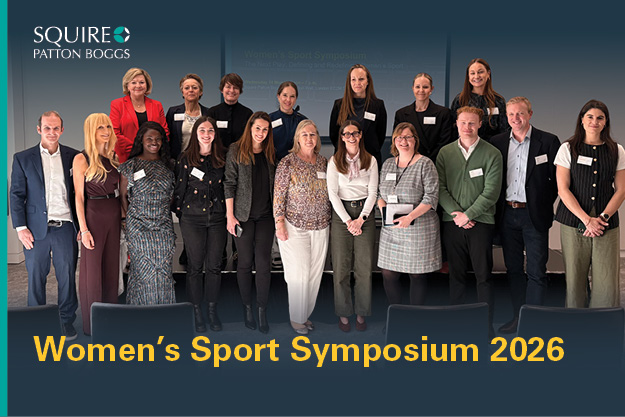
Women’s Sport Symposium 2026: Key Takeaways

Squire Patton Boggs’ Women’s Sport Group hosted its third annual Women’s Sport Symposium on 18 March 2026, in London.

Senior stakeholders and decision-makers from across the sporting landscape came together to drive meaningful dialogue on what’s next for women’s sport, all united in the determination to accelerate progress and sustain the extraordinary momentum achieved to date.

Across five dynamic panels, one thought‑provoking keynote and a special Q&A with a Commonwealth, World and Olympic champion, attendees heard from trailblazers shaping the industry today and redefining its future.

We will be unpacking each panel in more detail soon.  In the meantime, here are the key takeaways from the day.

Continue Reading

Driving Impact Through Women’s Sport Trust’s Unlocked Programme

We are proud to support Women’s Sport Trust and the impactful work taking place through its flagship Unlocked programme. Unlocked brings together elite female athletes from across the sporting spectrum, providing professional development, networking opportunities and visibility to accelerate their impact. It is a powerful example of how dedicated support can amplify female athlete voices, expand influence and contribute to a stronger, more equitable sporting landscape.

The programme is designed around a simple but powerful principle: athletes are uniquely positioned to influence progress, both within their sport and far beyond it. By providing access to strategic insight, tailored development opportunities and a cross-sport network of experienced professionals, Unlocked enables athletes to strengthen their leadership capabilities, build confidence and develop the professional skills needed to influence the areas that matter most to them.

Continue Reading

Copyright on Ice: The Intellectual Property Issues that Put the Milano-Cortina Olympic Figure Skating into Flutz

The Winter Olympics certainly generated its fair share of headline-grabbing stories over the last few weeks. In the figure skating, one of those stories was that surrounding Spanish skater, Tomas-Llorenc Guarino Sabate, and his now famed Minions-inspired routine.

As well as capturing the imagination of many fans with his yellow T-shirt and blue overalls costume, evoking the outfits worn by the distinctive pill-shaped creatures from the Despicable Me franchise, Sabate found himself at the centre of a copyright clearance issue for the “Universal Fanfare” track that he planned to incorporate into his routine.  

Sabate, however, was not the only figure skater to face such issues at the Milano-Cortina Games, with several others also encountering copyright clearance hurdles affecting their preferred choice of music.

This article examines the intellectual property considerations underpinning these matters and why they ultimately reached varying conclusions. It also discusses the key considerations that must be borne in mind when considering the use of creative works owned by another, especially at one of the most-watched global sporting events.

For further on the broader legal talking points and challenges impacting the XXV Winter Olympic Games, please see my colleague Henry Goldschmidt’s Sports Shorts article: High stakes: Traversing the legal terrain of Milano Cortina 2026™.

Continue Reading

High stakes: Traversing the legal terrain of Milano Cortina 2026™

The upcoming Olympic Winter Games™ (6-22 February 2026) and Paralympic Winter Games™ (6-15 March 2026) will be spread across Milan, Cortina d’Ampezzo and the Alpine landscape of northern Italy (“Milan Cortina” or the “Winter Games”). Over 3,500 athletes from 93 countries will compete for 195 medals across 16 Olympic disciplines and six Paralympic sports.

It is the first Olympiad under the stewardship of new IOC President Kirsty Coventry, who has openly acknowledged the “added additional complexities“ of organising and delivering a Games across an area spanning 22,000 km². Aside from the logistics of hosting a multi-sport international event of this magnitude, the IOC, Fondazione Milano Cortina 2026 (the Organising Committee for the Winter Games) and competing International Federations must contend with the geo-political climate, environmental pressures and integrity issues associated with elite-level competition.

In this article, I examine some of the legal talking points and challenges in the lead up to the Winter Games, as well as some of the flashpoints that could arise once the competition gets underway in earnest.

Continue Reading

Intervention or Interference? Examining the UK Government’s Shifting Role in Sports Governance

Introduction

Sport and politics have long been considered “uneasy bedfellows”, which might explain why the regulation of sport in this country has traditionally been left in the hands of sports governing bodies (“SGBs”) rather than the UK Government.  There has, however, been a gradual shift from strict non-interventionism to a more “involved” approach to sports governance through a combination of regulation, reform and investment. This has, in turn, led to a more intertwined and complex relationship between central Government and SGBs. 

Perhaps the most obvious example of the UK Government intervening in the sports sector is the landmark Football Governance Act 2025 (the “FGA”)[1], which recently became law after receiving royal ascent on 21 July 2025. Among other things, the FGA establishes an Independent Football Regulator (“IFR”) to oversee the top five tiers of English football, implementing one of the core recommendations from the 2021 Fan-Led Review of Football Governance.  The response of the football industry (and wider public) to the FGA has been very polarising and raised several broader questions about potential long-term consequences of state regulation, as well as whether Parliament has sufficient oversight and expertise to dictate sports policy.  

This article examines (i) how and why the UK Government intervenes in sport, (ii) whether there is a limit to such intervention, and (iii) what the future might hold in this area considering recent trends. 

Continue Reading

Sport on Steroids: Walking the ethical and legal tightrope of The Enhanced Games

There has been a raft of so-called “disruptor” competitions – backed by private equity – entering the sports and entertainment market in recent years.  However, I am not sure that any have been as controversial, polarising and daring as The Enhanced Games (“TEG”), where the use of performance-enhancing drugs (“PEDs”) will be permitted.

The organisers of TEG have recently announced the inaugural competition will take place in Las Vegas in May 2026. It has been marketed as bold stand for scientific freedom and personal choice – one that challenges the status quo and embraces “superhumanity” through pharmaceutical and technological innovation. Needless to say, it has attracted intense criticism from much of the sporting establishment, with the IOC describing TEG as “a joke, unfair and unsafe”.[1]  

The prevailing view on TEG seems to be one of overwhelming concern, rather than seeing it as a visionary breakthrough. Nevertheless, it has undeniably forced a broader conversation about the limits of human potential and the costs of surpassing them. In this article, I will examine the perspectives on both sides of the fence, as well as the potential legal issues that may arise.

Continue Reading

Approved NCAA v. House Settlement Leaves Open Ended Legal Questions

Basketball

After five years of litigation and negotiations, an antitrust settlement between the NCAA, the Power Five Conferences (Pac-12, Big Ten, Big 12, SEC, and ACC), and current and former Division I student-athletes has been approved by U.S. District Judge Claudia Wilken. The landmark agreement reshapes the collegiate sports world as it completes the NCAA’s transition away from amateurism and sets the terms on how student-athletes can be compensated.

While the settlement resolves many of the issues raised in litigation, the agreement creates a host of potential legal ambiguities, and its implementation poses serious challenges that will need to be resolved in the future.

Continue Reading

A back-to-school guide on revenue-sharing for female collegiate athletes

Sarah Rathke recently published a piece with Cleveland.com about the NCAA’s new “House” settlement. Effective July 1, 2025, this will allow colleges to share revenue with student-athletes, but it leaves unresolved questions about gender equity, especially under Title IX. While Power 5 schools and most Division I programs have opted in, early data shows a vast majority of funds going to men’s sports, raising concerns about fairness and legal compliance.

Read more here.

Courtside With Women’s Sports:  NIL, Women’s Collegiate Athletes, And The Law

I’ve been listening to Deja Kelly’s fascinating podcast, NILosophy.  Kelly is a lights-out women’s basketball player, and a talented broadcaster.  She and her guests – often but not exclusively young women – discuss the changing college sports world under NIL.  And many times during these interviews, I have been struck by how quickly these young athletes have to grow up, and the sophisticated adult decisions they are called upon to make. 

Many of these decisions have legal implications, but very few collegiate athletes have any legal training.  Therefore, I wanted to use this post to highlight some common scenarios where athletes may benefit from legal advice in a NIL collegiate world.

Continue Reading

Case Spotlight – Exclusive Surrey golf club forced to “take a Mulligan” over treatment of allegedly cheating member

Golf

Being a keen club golfer (although not one with any actual skill), a case that caught my eye in the last few weeks was the case of Rohilla v The Members of Royal Mid Surrey Golf Course.  As well as being a very detailed insight into the workings of an exclusive Surrey golf club, the case provides a few useful lessons on how, and more importantly how not to, remove someone from a membership who (allegedly) broke the rules and/or was quite unpopular.

Continue Reading

LexBlog